Frequent Questions
Answers to the most common questions about our aronia products, aronia plants, and your order.
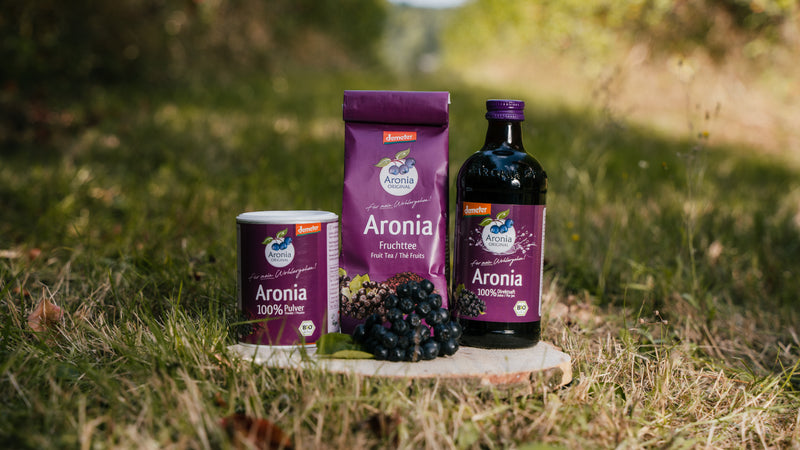
Origin, recommended consumption, shelf life, Organic & vegan.
The aronia berry, also known as chokeberry or black mountain ash, is a small berry originally native to the forests of North America. The indigenous people valued the berry even then and used it, especially mixed with fat, as winter provisions. Their horses were also fed with berries and leaves as a supplement. Around 1900, the aronia berry was first brought to Europe, where it was initially cultivated mainly in Russia and, from the 1970s, in other Eastern European countries.
Why could the berry survive even in distant Siberia? Due to its special properties, it can withstand extreme temperatures down to -35°C. From the mid-1970s, the first cultivation attempts were also made in the former GDR. Saxony is, so to speak, the cradle of the German aronia berry, and it is certainly no coincidence that we at Aronia ORIGINAL are based here. From here, plantations were cultivated in numerous regions following the Saxon model. In this country, the berry is particularly appreciated for its unique taste. For example, it is excellent for making juice, jam, or as an ingredient in smoothies.
Find your ideal juice amount. We recommend drinking about 100 ml of aronia juice daily after a meal or in the late afternoon. The juice can be consumed pure or diluted 1:1 or 1:2 with good water or mixed with other juices. The ideal daily amount of other aronia products is 1–2 tbsp of dried aronia berries or 1 tbsp of aronia berry powder.
It’s a matter of taste!
Our juice is perfect mixed with water as a refreshing fruit drink. You can easily add the dried aronia berries to your breakfast muesli. If you enjoy fresh smoothies or fruity quark, our aronia berry powder is perfect for you. Like variety? Then vary your daily portion of aronia.
Decide for yourself what suits you best.
Aronia juice in bottles: After opening, store the bottles in the refrigerator and consume the juice within 10 days if possible.
By the way: not-from-concentrate juice should be protected from light and air to ensure the highest possible quality. For our not-from-concentrate juices in the 0.7-liter size, we have developed special brown glass bottles that protect against light. The screw cap is equipped with a so-called cap head notch. If the contents unexpectedly start to ferment, the pressure escapes through a membrane in the cap. This reduces the risk of bursting glass bottles, and you can immediately tell from the cap bulging if something is wrong.
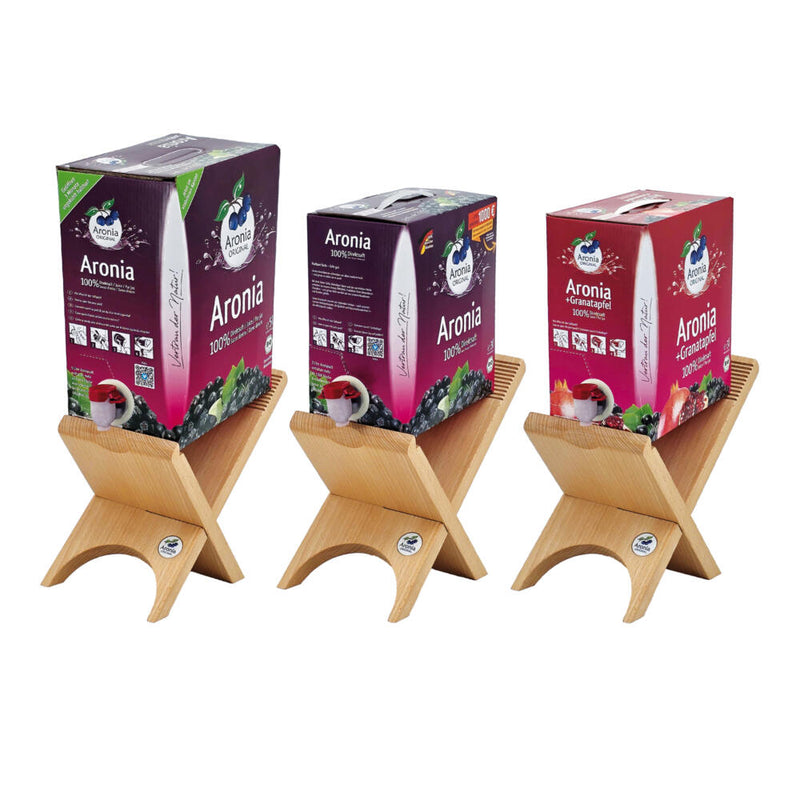
Aronia juice in 3 l bag-in-box or 5 l bag-in-box: Don’t be afraid of large quantities! In the practical bag-in-box with a vacuum tap, the 100% not-from-concentrate juice keeps for three months without refrigeration. You will find instructions for correctly opening the box on the carton.
Important: When opened, do not turn the carton backwards or upwards, as this could allow air to enter and affect the juice quality. Transferring the juice to bottles can also affect its shelf life. By the way, the 3 l bag-in-box is ideal as a monthly ration for 100 ml of aronia berry not-from-concentrate juice per day.
Tip: When the inner bag is almost empty, the carton should be tilted slightly towards the tap. This prevents air from entering the bag when there is only a little juice left.
This is a question of quality: Is the juice a not-from-concentrate juice or aronia juice made from fruit juice concentrate? Does the aronia juice come from the first pressing? For mixed juices, what is the proportion of aronia juice? Are organic aronia berries used? Where do the berries come from? Are they sourced directly from the grower or from the trade market? Where are they pressed and bottled? All these considerations and many more play a crucial role in pricing.
With Aronia ORIGINAL aronia juices, you can be sure: 100% not-from-concentrate juices in not-from-concentrate juice quality from organic aronia berries from German, Austrian or Polish organic growers, sourced, pressed and bottled directly in experienced juice presses.
Yes, all our currently available Aronia ORIGINAL products are organic certified. We provide proof of our organic products by listing the organic control body number as required by the authorities and displaying the EU Organic logo on the packaging.
The Aronia ORIGINAL core range, consisting of organic aronia berry juice, dried organic aronia berries and organic aronia berry powder, is completely free from added sugar or sweeteners and contains only the natural fruit sugar of the aronia berry.
For most of our products, we avoid using granulated sugar. If sweetening is necessary, we use alternative sweeteners such as agave syrup (e.g. in our organic aronia berry fruit spread). Exceptions are the dark-chocolate-coated aronia berries, the organic aronia berry jam Extra, the organic aronia mulled wine and the organic aronia mulled-wine spread: here, raw cane sugar is used for sweetening.
Many of our Aronia ORIGINAL products are now vegan. Please look for the Vegan Society’s Vegan Flower label. All products bearing the Vegan Flower on the label are vegan. No animal-derived ingredients have been used in the ingredient list, the manufacturing process or the packaging material.
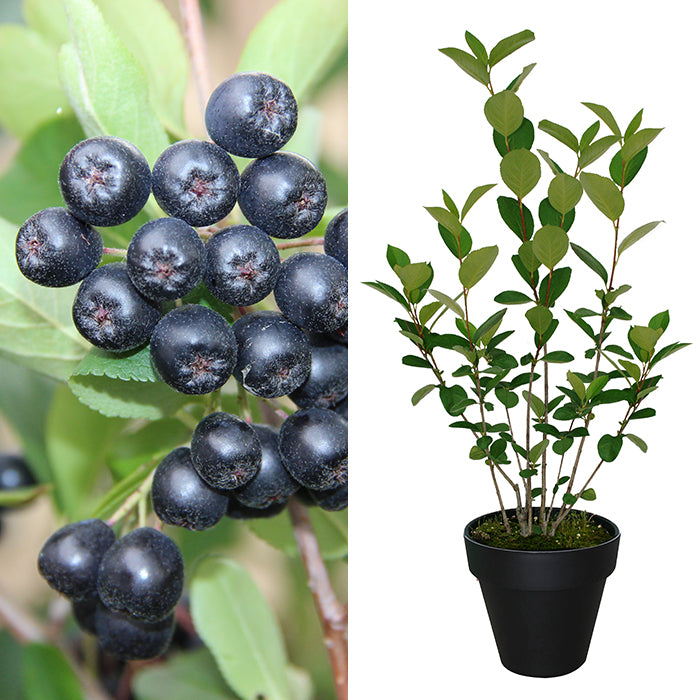
Location, planting time, care, harvest, and lifespan.
The optimal conditions for the aronia berry are found in the climate of Northern and Central Europe. Aronia can also adapt to harsh and cold weather. In contrast, Mediterranean, dry climates are unfavourable. Here, cultivation is only possible with a lot of effort and care, as the soil should have solid basic moisture. It is also possible to grow aronia bushes at altitudes of up to 1000 metres.
From flowering to harvest: How does aronia behave throughout the year?
From March, the first leaves sprout on the aronia plant. From late April to May, the aronia displays its white blossoms. The many small flower clusters delight garden lovers and bees alike. The first berries ripen from August to mid-September, depending on the weather. The variety is also crucial for the yield: For a solid yield, Aronia Nero Superberry is a good choice. From October, the leaves turn a vibrant red, adorn the autumn garden. After the leaves fall, the aronia plant overwinters at temperatures down to -35 °C.
Which location should you choose for aronia plants?
An ideal spot is sunny and bright. Light and summer warmth support the growth of new shoots and the formation of fruit sugar in the aronia berries. Partially shaded locations are also possible, though growth may be slightly reduced. Aronia plants can handle exposed weather conditions well. Avoid planting too close to walls, masonry, or under trees.
Over the years, aronia bushes develop strong roots with vigorous lateral shoots, reaching root depths of up to 2.00 m.
Ideal soil conditions for aronia plants
In principle, aronia plants can adapt to various soil conditions. Mixed soils of sand and clay are ideal. Consistent soil moisture can also be beneficial. Unfavorable conditions include soil that is too dry or very calcareous. Pure clay or sandy soil can hinder (inhibit) plant growth.
When is the optimal planting time?
Aronia plants can be planted in spring, ideally before the flowering period in May, or in autumn. It is important that the soil is frost-free. The period from September to early December is ideal. Over the winter months, the aronia plant can acclimate to its new location and grow vigorously in spring.
In our planting and care guides for potted and bare-root aronia plants, we have summarized everything important. Simply visit the subpage Aronia plant advice.
This depends on how you want to integrate aronia into your garden: as a useful plant for a rich harvest, as an ornamental plant, or as a hedge. Both are possible.
Aronia is perfectly suited as a useful plant in a solitary position. Here, the spacing should be at least 0.80 m to 1.20 m. Tip: Choose a more generous space. This way, you can pick the aronia berries more comfortably later on.
For an aronia hedge, we recommend a spacing of 0.40 m to 0.60 m, depending on how dense you want the hedge to be. Note that aronia bushes lose their leaves in late autumn.
Is it possible to plant aronia in a pot for a balcony or terrace? Of course! A ceramic or clay pot with a size of 20 liters or more is best, as aronia has strong, vigorous roots. Proper watering is especially important here. Avoid waterlogging. Fertilize only if necessary and always choose a sunny location.
Pruning the aronia plant
When we deliver our aronia plants, no pruning is necessary. However, we recommend a formative pruning in the first and second year after planting to allow the aronia to grow vigorously. Later, pruning effort remains low due to the plant's even, calm growth. To rejuvenate or thin out the bush, you can cut individual shoots at the base.
Tip: Always prune plants in late autumn when they are leafless. This allows the aronia to grow vigorously in spring. Mark the shoots in summer that you want to cut due to poor leaf or cluster formation.
How to water and fertilize correctly
As a rule: In hot periods, aronia should be watered sufficiently. Be sure to avoid waterlogging. Sandy soil dries out quickly but is loose and permeable. Clay soil, on the other hand, tends to waterlogging and lack of air.
Aronia plants are very undemanding. Fertilize only if necessary with organic fertilizer, such as Bokashi+400. Be cautious with compost or manure, as both may contain lime, which can have a negative effect. Bark mulch is also not recommended, as it removes nitrogen from the soil. A good alternative is adding humus.
How can you recognize nutrient or water deficiency?
Nutrient deficiency first appears in the plant's leaves: The leaves lose their lush, deep green and appear pale, light green to yellowish. The aronia looks weak and lifeless.
With water deficiency, the plant will not develop or will shed secondary parts such as flowers, clusters, or berries. The leaves are also affected: They discolor prematurely and fall off.
I have no harvest, what could be the reason?
Even though aronia plants are very robust, it can happen that the harvest is small or non-existent. Possible causes include:
- the wrong location with too little or no sun
- the weather, such as a lot of rain and a cold year
- soil that is too sandy or too clayey
- nutrient deficiency (or too much fertilizer)
- the variety of aronia
August to September is harvest time for aronia berries. The exact timing depends on the altitude, weather conditions, and the number of hours of sunlight.
How can you tell if aronia berries are ripe?
With a simple test: Pick one or two berries from several clusters and cut them in half with a sharp knife. If the berry is dark violet all the way to the center, it has reached ideal ripeness.
Help! Birds are eating my ripe aronia berries!
Birds, especially blackbirds and starlings, are true aronia gourmets. As soon as the first birds start pecking at your aronia fruits, you can be sure: The aronia berries have reached an optimal ripeness.
Tip: Protect the plant, for example, with a bird net. It is important that the net is stretched to the ground so that animals do not get tangled and injured. To create additional space between the net and the bush, wooden stakes are a good choice. This keeps the dark fruits out of reach for animal visitors.
Concerns about consuming fresh aronia berries due to hydrogen cyanide content
Some of our customers have expressed concerns that fresh aronia berries may contain a significant amount of bound hydrogen cyanide (cyanide), which could be released when eaten fresh, making the fruits unsuitable for direct consumption.
Here’s the reassurance: Cyanide is only contained in the small seeds of aronia berries. To release it, you would have to finely grind a considerable amount of seeds in your mouth. Heat treatment, such as in juice or jam production, breaks down the hydrogen cyanide. According to the German Federal Institute for Risk Assessment (BfR), the daily limit is 75 micrograms of hydrogen cyanide per kilogram of body weight (ARfD). This means: An adult weighing 70 kg can, according to this assessment, consume up to 5.25 mg of cyanide per day without expecting adverse effects.
The seeds of 100 g of fresh aronia berries contain about 0.6 to 1.2 mg of bound hydrogen cyanide. A 70 kg adult could therefore consume between 438 g and 875 g of fresh aronia berries per day (and finely chew the small seeds), without the hydrogen cyanide content being concerning.
For comparison: The cyanide content of sweet apricot kernels, which are often sold as a snack, averages 2.4 mg per 100 g (Source: Max Rubner Institute).
So can you eat fresh berries?
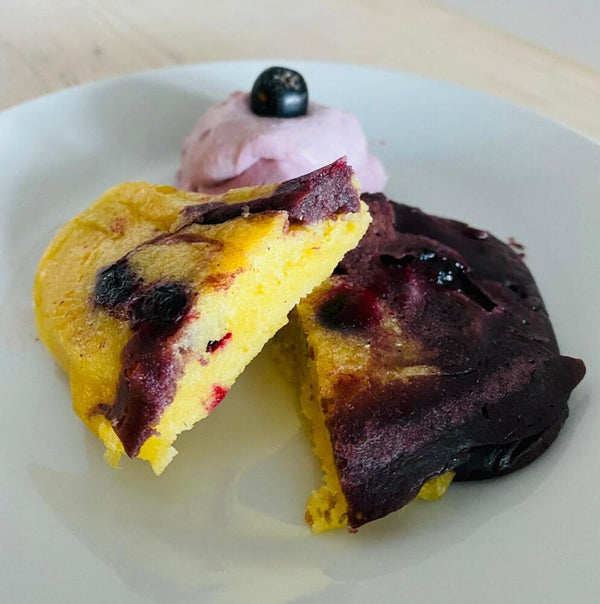
Absolutely! Fresh aronia berries can be enjoyed directly from the bush by both adults and children. Fresh aronia berries are versatile and creative in the kitchen, whether eaten fresh in small amounts, blended in smoothies, processed into homemade jam, or used as an ingredient in sweet cakes and desserts as well as savory sauces and chutneys.
The high content of dark plant pigments gives dishes a vibrant violet color. In terms of taste, fresh aronia berries are tart and slightly bitter, making them suitable for both sweet and savory preparations.
Lifespan and fruit yield of aronia plants
Aronia plants can reach an impressive age of 35 to 50 years. In Siberia, there are even plants said to have lived up to 60 years. A strong plant, such as the Aronia Nero Superberry variety, can regularly bear berries for a period of 25 to 30 years.
Age of plants in the Aronia ORIGINAL Shop
The bare-root plants offered in the Aronia ORIGINAL Shop are about two years old and reach a height of approx. 30 to 40 cm. The potted plants are shipped at the age of three to 3.5 years and have a size of 60 to 80 cm.
Customer account, payment, shipping, vouchers, and complaints.
Shopping options in the Aronia ORIGINAL Shop
In the Aronia ORIGINAL Shop, you can also shop as a so-called "guest buyer". This means that only the necessary billing and delivery address will be stored in connection with your order. However, if you shop with Aronia ORIGINAL more frequently, you will have to re-enter this data each time.
If you create a customer account (free of charge and without obligation), our online shop will "remember" your details. Setting it up is very simple: you can create your customer account at any time via the shop’s login page or during your order.
Your advantage: You can place orders more quickly on your next purchase and always have an overview of your orders and shipping status. You also have the option to subscribe to our juice subscription.
Convenient shopping in the Aronia ORIGINAL Online Shop
You can conveniently purchase Aronia ORIGINAL products in our online shop and choose from various common payment methods, such as credit card, PayPal and purchase on account. You can see which payment methods are currently available during checkout and on our Payment Methods page.
Shipping costs at Aronia ORIGINAL
The shipping costs depend on where you are ordering from. For shipments within Germany, the shipping costs are €4.95. Orders over €35 qualify for free shipping! If you order from abroad, Aronia ORIGINAL charges €9.90 in shipping costs, depending on the value of the goods and the destination country. The exact shipping costs will be displayed during the ordering process. You can find all the details on our Shipping & Delivery page.
How to redeem your voucher in the Aronia ORIGINAL Shop
The process is very simple. Just follow these steps:
- Shop as usual in the Aronia ORIGINAL Shop.
- Go to checkout and enter your voucher or discount code in the "Voucher code or gift voucher" field.
- Confirm the entry, and the discount will be automatically applied to your order.
The voucher code does not work in the online shop!
Make sure to enter the voucher code without "quotation marks" and confirm the entry. Also check the validity of the voucher: it cannot be redeemed after the expiry date. If in doubt, please contact our customer service and call us Mon–Fri from 08:00 to 16:30 on the Aronia hotline:
Phone number: +49 (0) 351 896 659 0 (6 cents/min from the German landline; mobile rates may vary). Please have your order number ready (you can find this in the order confirmation email or on your delivery note or invoice).
Order confirmation in the Aronia ORIGINAL Online Shop
After completing an order in our online shop, you should receive a confirmation at the email address you provided in the shop. If you have not received a message, there could be several reasons:
a) Did you enter your email address correctly?
Sometimes typos can occur, such as "@T-Onilne.de" instead of "@T-Online.de". Please check your email address and, if you find an error, contact us. We will correct the address and resend the confirmation.
b) Have you checked your spam folder?
It can happen that the order confirmation is incorrectly classified as "Unknown" or "Spam" by some (free) email providers. Please move the email to your inbox and, if necessary, mark it as "not spam" so that future emails do not end up in the wrong folder again.
Login without a password
In our new shop, there are no passwords anymore. You only log in with your email address: enter it on the login page of your customer account, and you will immediately receive a six-digit code by email. Use this code to log in. A password from the previous shop is no longer needed and cannot be reset. Of course, you can also place orders without a customer account.
The code has not arrived?
Please check your spam folder and verify that you used the email address with which you placed your order with us. The code is only valid for a few minutes; if needed, simply request a new one.
You no longer have access to your previous email address?
Then please contact us via the contact form or at mail@aronia-original.de and provide your new email address, a previous order number and your billing address. After this check, we will update your customer account with the new address. For data protection reasons, we only change email addresses in this way.
Complaints at Aronia ORIGINAL
If you notice a defect when unpacking your Aronia ORIGINAL products after purchase, please contact us as soon as possible. You can do this either online via our complaint form or alternatively by phone via the Aronia ORIGINAL hotline at +49 (0) 351 896 659 0.
Please state where and when you purchased the product, as well as your customer number (if you ordered via the Aronia ORIGINAL Online Shop) and your contact details.
Important information:
- Keep the packaging of the damaged or spoiled goods ready.
- We need the product name, weight, batch number and/or the best-before date of the affected product to support our quality assurance.
- If you wish to complain about the product quality, please keep it as intact as possible and send us a photo if the defect is visible (e.g. broken glass, burst bag-in-box, etc.).
Our customer service team will contact you promptly, and together we will find a solution to the problem!
Didn't find what you were looking for?
We’re happy to help personally: Mon–Fri 8:00–16:30 at +49 (0)351 896 659 0 or via the contact form.