The Aronia plant
The dark violet aronia berry grows in heavy clusters on robust shrubs. Over 100 years ago, the plant came to Central Europe via Russia and Eastern Europe. Today, it is gaining more and more fans as a local fruit.
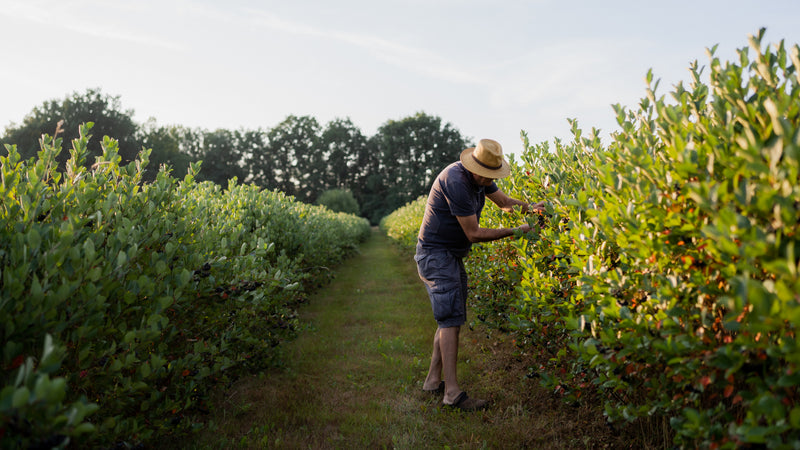
The appearance of the aronia plant
The aronia plant is a deciduous shrub up to 2 meters tall with pointed, strikingly wine-red winter buds. The leaves are 2–8 cm long and finely serrated. The white flowers on corymbs do not open until mid-May, so late frosts often spare the blossoms.
By August, round, almost black berries of 6–13 mm (about the size of blueberries) ripen, with up to 30 per cluster. When cut open, the fruit reveals intensely red flesh with symmetrically arranged seeds: the darker, the riper. Full ripeness is reached from late August to early September.
Four seasons, one shrub
Flowers on corymbs. The late flowering often avoids late frosts.
Full ripeness: almost black berries, 6–13 mm, up to 30 per cluster.
The shrubs glow in vibrant red before shedding their leaves.
Without leaves, the shrub withstands snow and frost down to −35 °C.
A little aronia every day!
Whether as pure not-from-concentrate juice or mixed juice, as powder for smoothies and bowls, as a spread or tea: We process our aronia into high-quality foods for every day.


At home and on the plantation
Growing aronia in your own garden is something almost anyone can do. The plant is quite undemanding, just not fond of heavily clay or sandy soils. And: the more sun, the sweeter the fruit. If you're considering a whole plantation of 5 hectares or more, you can also contact us, as we are always looking for cooperation partners as buyers and marketers of organic aronia berries.
What types of aronia plants are there?
From the wild varieties of the black-fruited chokeberry (Aronia melanocarpa), the plum-leaved (A. prunifolia), and the hairy chokeberry (A. arbutifolia), various cultivated varieties for gardens and orchards have been developed through breeding and selection. The wild varieties usually remain shorter than the cultivated ones.
 Exclusive at Aronia ORIGINAL
Aronia Nero, the superberry
in plantation quality!The ‘Aronia Nero’ selection for your home garden, terrace or balcony grows up to 2.5 m tall and produces large panicles with berries weighing 1.0–1.5 g.
Aronia plant advice from the expert
Pruning and planting guides for potted and bare-root plants, plus many tips about your aronia plant.


